What is an SME IPO? The Complete Guide for Retail Investors
 Staff Editor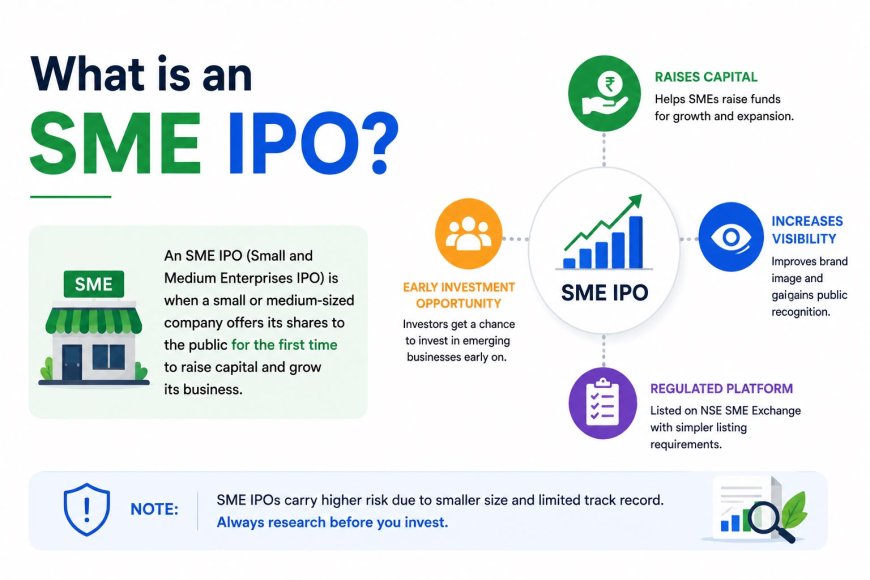
An SME IPO (Small and Medium Enterprise Initial Public Offering) is a process through which early-stage or medium-sized privately held companies raise capital from the general public. Instead of listing on the main stock exchange, these companies list their shares on dedicated platforms like BSE SME and NSE Emerge. To qualify as an SME IPO, the company’s post-issue paid-up capital must not exceed ₹25 crores. Because these businesses are smaller and carry higher risk, regulators mandate a much larger minimum investment size—typically around ₹1 Lakh—to ensure only financially capable and risk-aware investors participate.
The IPO GMP(Grey Market Premium) plays an incredibly vital role when you evaluate Small and Medium Enterprise (SME) public offerings. Because SME IPOs require a large minimum investment of over one lakh rupees and face unique trading liquidity constraints, understanding early market demand is essential for retail individual investors. A positive premium shows that unofficial traders are ready to pay extra money for the corporate shares, which often points toward a profitable opening on listing day. You can monitor these volatile day-wise premium movements safely on the dedicated tracking pages of IPO INDEX to make well-researched financial choices before the official bidding begins.
For decades, the stock market was an exclusive club for multi-billion-dollar conglomerates. If a small manufacturing firm in Gujarat or a boutique tech startup in Bangalore wanted to raise capital to expand, their only options were taking on crushing bank debt or relying on private venture capitalists.
The Securities and Exchange Board of India (SEBI) recognized this massive gap in wealth creation and corporate funding. To democratize capital, specialized trading platforms were created: the BSE SME and the NSE Emerge. These platforms act as incubators. They allow high-growth, fundamentally strong small businesses to tap into public money without facing the overwhelming compliance costs and massive valuations required to list on the mainboard stock exchange.
Today, the SME IPO space is one of the most exciting, high-adrenaline segments of the Indian financial market. It gives retail investors the rare opportunity to get in on the "ground floor" of a company before it potentially grows into a large-cap giant.
How Does an SME IPO Work? The Mechanics
While the ultimate goal of raising money is the same, the mechanics of bringing a Small and Medium Enterprise to the public market are distinct. Here is how the process unfolds:
1. Hiring a Merchant Banker and 100% Underwriting
The first step for the company is to hire a Lead Manager or Merchant Banker. In the SME space, the underwriter plays a much more critical role than in mainboard IPOs. SEBI mandates that SME issues must be 100% underwritten. This means the merchant bankers and their syndicates guarantee that if the public does not buy the shares, the underwriters themselves will step in and buy them, ensuring the company gets its required funding.
2. Vetting the Draft Prospectus
The company and its bankers prepare a Draft Red Herring Prospectus (DRHP) detailing their business model, financials, and the objective of the issue. Interestingly, unlike mainboard IPOs where SEBI directly reviews and approves the document, the DRHP for an SME is vetted and approved directly by the respective stock exchange (BSE or NSE). This accelerates the approval timeline significantly.
3. The Public Bidding and Minimum Application Size
Once the dates and price bands are set, the issue opens to the public. However, the entry barrier is much higher. In a standard IPO, a retail investor can apply for a single lot worth ₹14,000 to ₹15,000. In an SME IPO, SEBI enforces a minimum application size that usually ranges between ₹1,00,000 and ₹1,40,000 per lot. This acts as a strict financial filter to keep inexperienced, small-capital investors away from high-risk equities.
SME IPO vs. Mainboard IPO: The Core Differences
Understanding the distinction between these two markets is crucial for your investment strategy. Here are the defining differences separated by key metrics:
Eligibility Criteria: Ensuring Quality Control
Because the barrier to entry is lower, regulators have continuously updated the rules to ensure that shell companies or failing businesses do not exploit the public. Recent guidelines ensure strict quality control:
Why Are Investors Flocking to the SME Segment?
If the minimum investment is ₹1 Lakh and the risk is high, why are these issues constantly oversubscribed by 100x or 200x?
The answer is wealth multiplication. Because these companies have small market capitalizations, it takes very little buying pressure to push the stock price up. It is not uncommon for a highly anticipated SME IPO to list at a 100% or even 200% premium on day one. For an investor who allocated ₹1.2 Lakhs, doubling their money in less than a week is a magnetic proposition. Furthermore, finding a fundamentally brilliant company in the SME space means you are investing at a micro-cap valuation, offering the potential for massive multibagger returns over a 5 to 10-year horizon.
The Hidden Risks Every Investor Must Know
High rewards never come without high risks. The SME space is notoriously unforgiving for unprepared retail investors. You can calculate you return of your investment in SIP Return Calculator.
Because SME shares are traded in heavy lots, liquidity can dry up instantly. If negative news hits the company and the stock hits its lower circuit limit, there may be zero buyers in the market willing to purchase a block of 2,000 shares at ₹1.5 Lakhs. You could be trapped in the stock for days, watching your capital erode without the ability to execute a sell order.
High Volatility and Price Manipulation
Small companies are easily swayed by market operators. With fewer shares available in the open market (low free float), a wealthy group of traders can artificially inflate the price of an SME stock, lure in retail investors, and then dump their shares.
Unlike giant corporations with massive cash reserves, a small enterprise is highly vulnerable to macroeconomic shocks. A sudden increase in raw material costs, a delayed client payment, or the loss of a key promoter can entirely derail the company's profitability.
How to Evaluate an SME Before Applying
Do not let the fear of missing out (FOMO) dictate your capital allocation. Use these strategic steps to evaluate your next SME application:
Frequently Asked Questions (People Also Ask)
Can I buy just 1 share of an SME IPO after it lists?
No. Unlike mainboard stocks where you can buy a single share, SME stocks must be bought and sold in predefined lot sizes even in the secondary market. If the lot size is 1,200 shares, you must trade in multiples of 1,200.
When does an SME company move to the mainboard?
An SME can migrate to the mainboard stock exchange (NSE or BSE) once its post-issue paid-up capital crosses ₹10 crores, provided it meets other specific profitability and shareholder criteria. It becomes mandatory to migrate or delist if the capital crosses ₹25 crores.
Are SME IPOs riskier than regular IPOs?
Yes, they are significantly riskier. They carry higher business execution risks, lower regulatory reporting requirements (half-yearly vs. quarterly), and extreme liquidity constraints due to lot-size trading.
Where can I check the allotment status of an SME IPO?
You can check the live allotment status, track subscription data, and monitor the pre-listing sentiment through the centralized dashboard at IPOIndex.in.
Conclusion: Navigating the Micro-Cap Frontier
The SME IPO market is not for the faint of heart. It is a high-octane environment where fortunes can be made or lost in the blink of an eye. By understanding the strict exchange regulations, the mechanics of lot-size trading, and the massive difference between micro-cap growth and market manipulation, you can navigate this space safely.
Treat every SME application as a serious business investment, not a lottery ticket. Read the prospectus, respect the liquidity risks, and follow the fundamental data.
Are you ready to discover the next big micro-cap opportunity? Bookmark IPOIndex.in right now. Use our platform to track live SME subscriptions, analyze daily grey market trends, and make your investment decisions based on hard data rather than market rumors. Drop a comment below if you have ever successfully applied for an SME IPO!
Vikram S. is a seasoned financial analyst and equity market researcher with over a decade of experience navigating the Indian stock market. Specializing in primary market offerings and retail investor advocacy, Vikram breaks down complex financial data into actionable strategies. When not analyzing Red Herring Prospectuses, he frequently contributes insights on market sentiment and wealth generation.
Disclaimer: This article is for educational and informational purposes only and should not be considered financial or investment advice. Readers should do their own research before making any investment decisions. We are not responsible for any financial losses based on this content.